Do you need planning permission for solar? A W5 postcode answers better than a rulebook
Most British houses can take panels without asking anyone. One street in Ealing shows the four exceptions that actually matter, and how to check your own address in an afternoon.
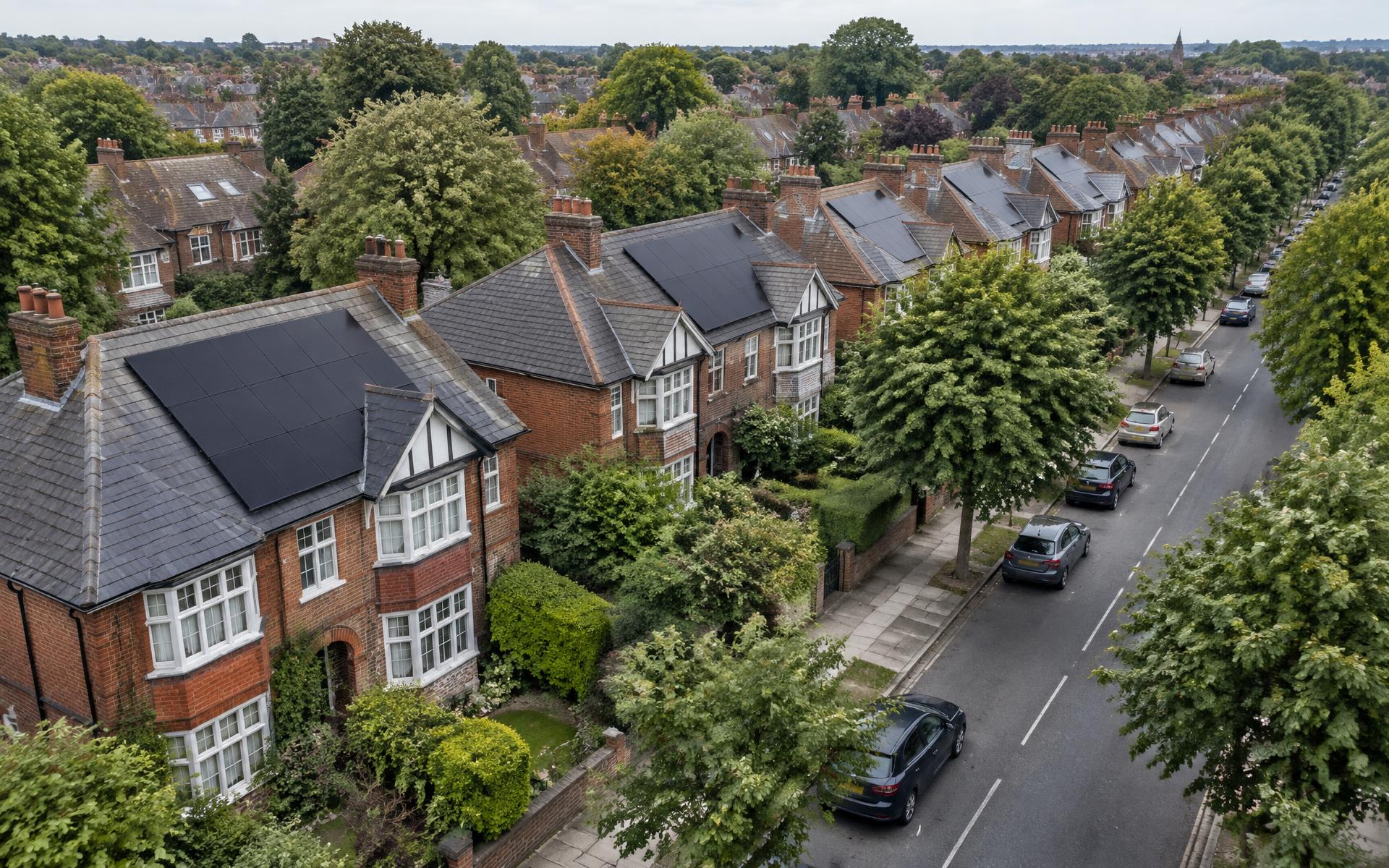
Most English houses can take rooftop solar without planning permission, because it is permitted development: panels must project no more than 20 cm above the roof slope, stay at least 1 metre from the roof edge, and be sited to minimise visual impact. The exceptions are local and checkable: an Article 4 direction (in Ealing, six of 32 conservation areas, including Hanger Hill Garden Suburb in W5), listed building status, flats and maisonettes (which have no householder permitted development rights and also need freeholder consent), and private restrictive covenants in the title deeds. All four can be checked free in an afternoon. In Haven Green Conservation Area, rear slopes still qualify under permitted development, but street-facing panels need a full planning application, and flats need permission whichever way they face.
Most of the time, the answer is no. Solar panels on a house in England are permitted development, which means the planning system has already granted permission in advance, provided the installation stays inside a short list of conditions. The panels must not stick up more than 20 centimetres above the roof slope. They must not come within a metre of the roof's outer edge. They must be sited, so far as practical, to minimise their effect on how the place looks.
For the great majority of British houses that is the whole conversation. You do not write to the council, you do not pay a fee, you do not wait eight weeks. The permission exists before you thought of the project.
But permitted development is a national rule with local holes in it, and the holes are not evenly spread. To see where they are, take one postcode and walk through it properly. We will use W5, in Ealing, west London, because it contains every exception you are likely to meet anywhere in the country, inside a few square miles.
The standard case
A typical 1930s semi in Ealing, slate roof, street-facing front slope, garden slope at the back. Panels on either slope, kept 20 cm proud of the tiles at most and a metre clear of the verge and eaves. That is permitted development. Ealing, like almost every English borough, applies the national rules without adding anything of its own for ordinary houses. The installer notifies the district network operator about the electrical connection, building control signs off the structure and wiring, and planning never comes into it.
If your house is like that one, you can stop reading. The rest of this essay is about the four ways a property stops being like that one.
Exception one: the Article 4 direction
Ealing has 32 conservation areas. A conservation area on its own does not remove your permitted development rights for solar; it adds a duty to think about appearance, which the standard conditions already do. What removes the rights is an Article 4 direction, a specific legal instrument a council layers on top of a conservation area when it wants each change judged individually.
Only six of Ealing's 32 conservation areas carry one. But W5 holds the best known of them: the Hanger Hill Garden Suburb and the neighbouring heritage estates. These are places built as deliberate compositions, and the council has decided that roofscapes are part of the composition. Inside an Article 4 area, panels on a street-facing slope need a full planning application, and the design controls that follow are real: all-black panels, hidden fixings, layouts that read as part of the roof rather than equipment bolted to it.
This is not a reason to abandon the idea. It is a reason to design for the back slope first, to specify discreet hardware, and to put the application in with drawings that show the council you understand what the estate is for. Applications like that get approved. Applications that ignore the character of the place do not.
Exception two: the building is listed
If the house is listed, at any grade, permitted development does not apply and you need listed building consent before anything touches the roof. This is a different test from planning. The question is not whether the panels harm the street but whether they harm the building's special interest, and the answer depends on the building: a panel array invisible from anywhere on a modern rear extension roof may be acceptable where the same array on original slate over the principal elevation is not.
Listed consent is slower and less predictable than planning, and it is the one case where the honest advice is to talk to the conservation officer before you talk to an installer, because the officer will tell you which roof, if any, they can say yes to.
Exception three: it is not a house
Permitted development rights for domestic solar belong to single-family houses. A flat, a maisonette, a share-of-freehold conversion, none of these has them. W5 is full of big houses divided into flats, and this is the exception that catches the most people, because the building looks exactly like the semi next door that needed no permission at all.
A flat needs a planning application for the panels, and before that it needs the freeholder's consent, because the roof of a converted house usually belongs to the freeholder or is shared, and the lease will say so. Two consents, in sequence: the lease first, the council second. Leaseholders who skip the first discover the second was the easy one.
Exception four: the covenant nobody mentioned
The last exception is not planning law at all. Parts of Ealing, like parts of many older suburbs, sit on land sold off by historic estates, and the original conveyances sometimes carry restrictive covenants: promises, binding on every later owner, not to alter the roofscape or the external appearance without the estate management's approval. The council cannot see these and will not tell you about them. They sit in your title deeds.
Most are old, loosely enforced, and cheap to satisfy: a letter, a drawing, a modest fee. But they are enforceable, and the time to find one is before the scaffolding goes up. Your conveyancer's report from when you bought the house will say whether any exist.
Key finding: an enquiry in the Haven Green Conservation Area
We ran this check for a real W5 enquiry, and the answer changed in one line. The address sits directly within the Haven Green Conservation Area.
Because of that, the standard permitted development answer does not carry across to the whole roof. What it means in practice splits the house in two.
On the street side: any roof slope or wall that faces a highway is not permitted development here. Panels there need a full planning application, and Ealing Council generally refuses or heavily scrutinises street-facing panels in its heritage areas, to protect the character of the roofscape. Where they are won through, the design controls are strict: flush-fitting, all-black, integrated panels that read as part of the roof.
On the back side: rear roof slopes, and side slopes not visible from a public highway, generally still qualify under permitted development, provided the standard constraints are met. The panels project no more than 20 centimetres above the roof plane, and sit at least a metre in from the outer edges and the ridge.
The same enquiry carries one more trap. If the building is, or becomes, a flat or a maisonette, permitted development does not apply at all — full planning permission is required whichever way the roof faces.
So the summary advice to that enquiry reads: rear roof, good to go under permitted development, so long as the 20 centimetre and one metre conditions hold. Front roof, street-facing, a full planning application to Ealing Council, with a real likelihood of refusal or strict conditions. And check the tenure before either, because tenure overrides both.
How to check your own address
Try it yourself: our free solar planning check walks you through the same steps — your postcode against the national heritage map, then the rules one roof slope at a time, with every source shown.
The whole check takes an afternoon and costs nothing.
- Search your council's website for its conservation area map and find your street. If you are in one, search for whether an Article 4 direction covers it.
- Search the National Heritage List for England for your address to confirm the building is not listed.
- If you own a flat or a share of freehold, read the lease for the roof and the alterations clause.
- Read the title deeds, or the conveyancer's report, for restrictive covenants.
Four searches. If all four come back clear, you are in the standard case, and the answer to the question in the title is no.
The shape of the thing
What the W5 walk-through shows is that solar planning in England is not a lottery. It is a short, knowable list. Height, edge distance, appearance. Article 4, listing, tenure, covenant. The first list is the same everywhere; the second is specific to your address and can be checked in an afternoon.
The cases that go wrong are almost never the complicated ones. They are the ones where nobody checked. A flat owner who assumed the semi-detached rules applied. A household inside a garden suburb that found out about Article 4 from an enforcement letter. None of that is necessary. The rules are public, the maps are online, and the exceptions, in Ealing and everywhere else, are a small set you can hold in your head at once.
Common questions
- Do I need planning permission for solar panels on my house?
- Usually not. In England, rooftop solar on a single-family house is permitted development, provided the panels project no more than 20 cm above the roof slope, stay at least 1 metre from the external edge of the roof, and are sited to minimise visual impact so far as practical.
- What is an Article 4 direction and does it affect solar panels?
- An Article 4 direction is a legal instrument a council applies to a specific area, usually a conservation area, to remove permitted development rights so each change is judged individually. In Ealing, six of the 32 conservation areas carry one, including Hanger Hill Garden Suburb in W5. Inside one, street-facing solar panels need a full planning application.
- Do solar panels need planning permission in a conservation area?
- A conservation area on its own does not remove permitted development rights for solar. Rights are only removed where the council has added an Article 4 direction, which covers a minority of conservation areas. Check the council's conservation area map and Article 4 register for your street.
- Can I put solar panels on a listed building?
- Yes, but you need listed building consent before any work, and permitted development does not apply. Consent depends on whether the panels harm the building's special interest, so arrays on invisible or modern roof slopes are far more likely to be approved than arrays on original principal elevations.
- Do flats need planning permission for solar panels?
- Yes. Permitted development rights for domestic solar belong to single-family houses only. A flat or maisonette needs a planning application, and the leaseholder also needs the freeholder's consent because the roof is usually owned or shared.
- What is a restrictive covenant and can it stop solar panels?
- A restrictive covenant is a binding promise in the property's title deeds, often dating from the original estate that sold the land, not to alter the roofscape or external appearance without approval. Councils cannot see covenants, so they will not warn you. Check your title deeds or conveyancer's report before installing.
- Can I put solar panels on the back of my house in a conservation area?
- Usually yes. Rear roof slopes, and side slopes not visible from a public highway, generally still qualify under permitted development even inside a conservation area, provided the panels project no more than 20 cm above the roof plane and sit at least 1 metre from the outer edges and ridge. Street-facing slopes are different: in areas like Ealing's Haven Green Conservation Area, panels facing a highway need a full planning application.
- Do solar panels on a street-facing roof need planning permission in Ealing?
- Inside Ealing's heritage areas, including the Haven Green Conservation Area, panels on any roof slope or wall facing a highway are not permitted development. They require a full planning application, and the council generally refuses or heavily scrutinises street-facing panels to protect the roofscape, approving only flush-fitting, all-black integrated designs where the character allows.